I have a confession to make.
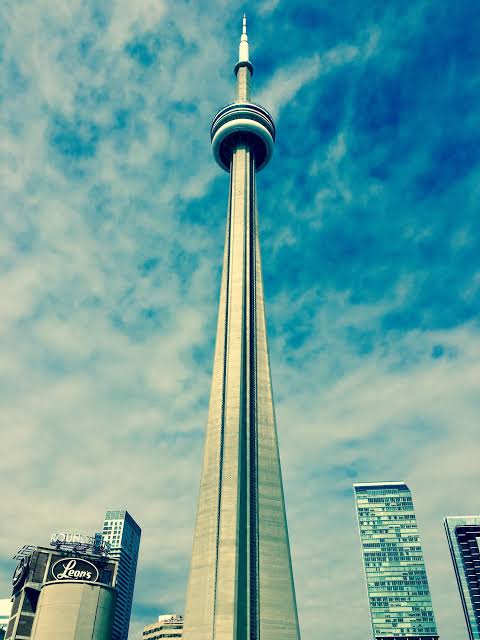
I’ve lived in Toronto for years now, and I still look up every single time I drive down the Gardiner Expressway. It doesn’t matter that I’ve seen it a thousand times. It doesn’t matter that I know exactly where it is. That concrete needle, piercing the sky like it’s trying to poke a hole in the clouds, still gets me.
That’s the thing about the CN Tower. It’s not just a building. It’s a feeling. A reminder that sometimes, the most practical things in life become the most magical.
From Radio Signals to Rock Star Status
Here’s the part that always makes me smile: the CN Tower was never meant to be a tourist attraction. It was born out of a problem.
Back in the 1960s, Toronto was growing up—literally. New skyscrapers were popping up everywhere, and they were blocking radio and television signals across the city . The signals were bouncing off buildings instead of reaching homes. It was a mess.
So Canadian National, the railway company, stepped in with a solution: build a really, really tall tower. One that could broadcast signals far and wide, over the heads of all those new buildings .
They didn’t set out to build an icon. They set out to fix a technical glitch.
But somewhere along the way—through 40 months of construction, 1,500 workers, and a whole lot of concrete—it became something more . It became ours.
The Numbers Still Feel Unreal
Let me throw some stats at you, because they genuinely don’t feel real.
The CN Tower stands at 553 metres tall . For 33 years, it was the tallest free-standing structure in the world, until Dubai’s Burj Khalifa came along in 2009 and ruined the party . But honestly? Who cares about being number one. The CN Tower was the first of its kind, the original giant, the one that proved it could be done.
Construction started in February 1973. They moved over 56 metric tonnes of earth and shale just for the foundation . The concrete shaft rose using a massive slipform that climbed upward as the concrete hardened, tapering as it went . By August 1974, they started building the seven-storey sphere that would become the observation decks and the restaurant .
And then came Olga.
In March 1975, a giant Sikorsky helicopter named Olga flew into Toronto to lift the 39 pieces of the antenna into place . Can you imagine looking up and seeing a helicopter dangling pieces of a tower into the sky? That’s the kind of thing that makes you stop and stare.
The tower opened to the public on June 26, 1976 . And Toronto has never been the same.
What It Feels Like to Stand on Glass
I’ll be honest. The first time I stepped onto the Glass Floor, I almost chickened out.
It’s one thing to know, logically, that the glass can hold the weight of several adult elephants . It’s another thing entirely to stand on it and look straight down at the city below—342 metres of nothing between you and the streets .
My heart raced. My palms got sweaty. And then I laughed. Because it was absurd. It was thrilling. It was fun.
The Glass Floor recently got a $21 million renovation, with interactive video walls and an even wider glass surface . But the feeling is the same: that dizzying, exhilarating reminder that you’re standing on air.
And if you’re truly brave? There’s the EdgeWalk—the world’s highest full-circle, hands-free outdoor walkway . You step outside, harnessed to a rail, and walk along the edge of the tower at 116 stories up. You can even lean over the edge.
I haven’t done it. I’m not sure I will. But I love that it exists. I love that people come from all over the world to do something that terrifies them, just to say they did it.
The Restaurant That Spins (Slowly)
The 360 Restaurant completes a full rotation every 72 minutes . That’s slow enough that you barely notice you’re moving, but fast enough that your view of the city is completely different by the time dessert arrives.
I’ve had dinner there once. It was expensive. The food was good, not life-changing. But the view? The view was everything. Watching the sun set over Lake Ontario, the city lights flickering on one by one, the grid of streets glowing gold and white below—it felt like watching Toronto breathe .
You’re not paying for the meal. You’re paying for the memory.
The Tower That Became a Symbol
Here’s what I love most about the CN Tower. It’s not just a tourist attraction. It’s a symbol.
When Drake released Views in 2016, he didn’t put the Rogers Centre on the cover. He didn’t put the skyline. He put the CN Tower . Because that’s what Toronto looks like. That’s what home looks like.
When the Raptors won the championship in 2019, where did people gather? Where did the celebrations happen? The tower was lit up in red. Because it’s the heartbeat of the city.
Culture writers have noted that the tower arrived at exactly the moment Toronto was coming into its own—the 1970s, when the city was shaking off its inferiority complex and becoming something bigger . The CN Tower was “big tower energy” before anyone knew what that meant .
It’s the thing you see on postcards. The thing you point to when you’re giving directions. The thing that tells you, you’re here. You made it.
A Gentle Warning
If you visit Toronto and skip the CN Tower, I won’t judge you. Not everyone loves heights. Not everyone wants to pay the admission. Not everyone cares about seeing a city from above.
But if you do go? Take your time. Stand on the Glass Floor and let your heart race. Have a drink at the restaurant and watch the world turn. Look out at Lake Ontario and realize how small we all are, and how beautiful it is to be part of something this big.
And when you leave, when you’re walking back to your car or the subway or wherever you’re headed next, do me a favour.
Look up.
Because that needle, that concrete giant, that accidental icon—it’s still there. Still standing. Still making people stop and stare.
And honestly? I hope it always will.