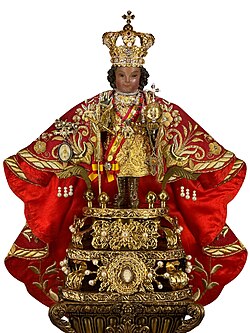
There are statues. And then there’s the Santo Niño de Cebu.
I’ve seen the photos. I’ve read the history. But nothing—and I mean nothing—prepares you for the weight of this story. It’s not just about a small wooden figure carved by Flemish artisans centuries ago . It’s about faith so stubborn, it survived fire. It’s about a Child who, in the eyes of millions, became a magnet of love for an entire nation.
The Gift That Started It All
Picture this: 1521. Ferdinand Magellan arrives in Cebu. He meets Rajah Humabon and his wife, Amihan, and gifts them a small image of the Child Jesus—about 12 inches tall, carved from dark wood, holding an orb topped with a cross . Soon after, Humabon and Amihan (baptized as Carlos and Juana) convert to Christianity alongside hundreds of their people .
Then Magellan dies in the Battle of Mactan. The Spanish flee. And for 44 years, that little Santo Niño stays in Cebu, quietly passing into native hands .
The Fire That Couldn’t Touch Him
Here’s where the story gets unbelievable.
In 1565, Miguel Lopez de Legazpi arrives with a new Spanish expedition. Tensions flare. The village burns. Houses go up in smoke .
And a soldier named Juan de Camus walks through the ashes. He finds three wooden boxes, untouched by the flames. Inside one of them? The Santo Niño—perfect, unharmed, as if the fire simply… refused to touch him .
Can you imagine that moment? The soldiers wept. They fell to their knees right there in the rubble . This wasn’t just a discovery—Kaplag, as they called it in Cebuano . It was a sign. A miracle. An answer.
Not a Tourist Show, a Love Story
Fast forward to today. Over 5 million people now flood Cebu for the Fiesta Señor every January . The streets vibrate with drums, the famous “Pit Señor!” chant, and the Sinulog Festival’s hypnotic dance. Tourists come for the spectacle.
But ask anyone from Cebu, and they’ll tell you the truth. “The feast is rooted in the deep Catholic faith of the Cebuano people and less of a tourist event,” says Sister Aileenette Mirasol, who was born and raised there . They call the Santo Niño the “Batobalani sa Gugma”—the Magnet of Love . This isn’t folklore. It’s devotion.
The Miracle That Keeps on Giving
Why does it endure? Because for so many, this isn’t just history. It’s personal. People weep at the Basilica Minore del Santo Niño, where the original image now rests behind glass . They come with prayers for healing, for family, for hope. And they leave believing the Holy Child has heard them .
It’s messy, this faith. It’s tangled with history that includes brutal colonization. But that’s what makes it a miracle in its own right. A symbol of unity that somehow outlasted the fire.
As Bishop Anthony Taylor once said, “The story of this evangelization is messy, but that’s part of the miracle” .
The Santo Niño didn’t just survive. He became the oldest Christian relic in the Philippines—and the heart of a nation .
So the next time you see that little crowned Child, with his gentle smile and raised hand in blessing, remember: He’s not just an icon. He’s a survivor. A bridge between worlds. And for millions of Filipinos, he’s proof that even in the ashes, something holy can remain untouched.
Pit Señor! 🕊️