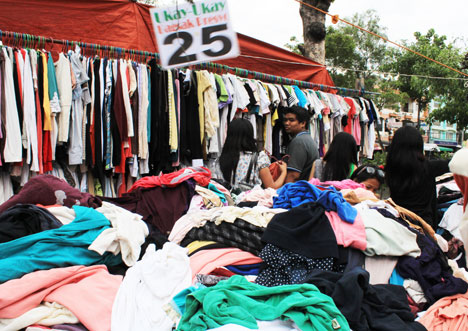
There’s a certain magic to walking into an ukay-ukay. The smell of old clothes mixed with the faint scent of detergent. The chaotic piles stacked high on tables. The buzz of shoppers sifting through racks like archaeologists on a dig. And that rush when your fingers brush against something special.
That’s the thrill. And it never gets old.
What Exactly Is Ukay-Ukay?
For the uninitiated, “ukay-ukay” (pronounced oo-ky-OO-ky) comes from the Filipino word halukay, which simply means “to dig up” . And that’s exactly what you do—you dig through piles of secondhand clothes, shoes, and accessories until you strike gold . Think of it as thrift shopping, but with more heart, more chaos, and way more personality.
These items usually come from countries like Hong Kong, Japan, South Korea, the US, and the UK, shipped in massive bales and sold at prices that’ll make your wallet breathe a sigh of relief . We’re talking branded shirts for PHP 20, vintage jackets for a couple hundred pesos, and the occasional designer find that makes you feel like you just won the lottery .
From Baguio to the Nation
The ukay-ukay story starts in Baguio City, the country’s thrift capital. It all began in the 1980s when the Salvation Army donated secondhand clothes to disaster victims . Local vendors bought the surplus in bulk and sold them at low prices, creating a system that helped families afford decent clothing after the 1990 earthquake .
From there, it exploded . What started as a practical solution for low-income families soon attracted everyone—students, artists, professionals, and even celebrities. Because who doesn’t love a good deal?
More Than Just Cheap Clothes
Here’s the thing about ukay-ukay: it was never just about saving money.
For many, it’s an act of self-expression. Unlike malls where everyone wears the same trends, thrift stores offer pieces with history and personality . You can experiment with styles you’d never try otherwise—oversized jackets one week, baby tees the next—without breaking the bank . As one thrifter put it, “I found a P50 pleated midi skirt that I still have with me today, even after moving thrice. It made me realize I didn’t really need to step into a mall to find clothing that gave me joy” .
It’s also become a social activity. Friends go together, digging through bins, trying on pieces, and laughing over the weird finds . In a world that moves too fast, ukay-ukay forces you to slow down. There’s no algorithm feeding you options, no curated feed—just you, your instincts, and piles of clothes waiting to be discovered .
The Sustainable Side
Let’s be honest: the fashion industry is a mess. Fast fashion churns out cheap clothes that fall apart, ending up in landfills. Ukay-ukay offers a better way .
Buying secondhand extends the life of garments, reduces waste, and lowers the demand for new production . In the Philippines, clothes that don’t sell are often repurposed into rags (basahan) or sold in bundles—nothing goes to waste . It’s the kind of circular economy that environmentalists dream about, but Filipinos have been practicing for decades without calling it that.
As one stylist observed, “Ukay-ukay slows down the demand for new clothing, with consumers prioritizing pieces that will stand the test of time over fleeting trends” .
But Things Are Changing
Here’s where it gets complicated.
In recent years, thrifting has gone mainstream. Online resellers now haunt ukay stores, scooping up the best pieces and selling them on Instagram or TikTok for triple the price—sometimes PHP 500 for a top that originally cost PHP 50 . They frame it as “vintage,” “rare,” or “curated,” and suddenly thrifting feels exclusive instead of inclusive .
Even the experience has shifted. Instead of chaotic piles, some shops now display items neatly like boutiques. Live-selling on social media lets you bid on pieces from your phone, turning the hunt into a digital competition .
And there’s a deeper tension: while ukay-ukay gives Filipinos access to affordable clothes, it also undercuts the local textile industry. Philippine-made fabrics can cost 30% more than imported secondhand items, making it harder for local artisans to compete .
The Soul Is Still There
Despite all that, the heart of ukay-ukay remains intact. Walk into any thrift shop in Cubao, Anonas, or Baguio’s Hilltop Market, and you’ll still see people digging through piles with the same excitement I felt as a kid .
That unpredictability is the whole point. There’s no guarantee you’ll find something, but when you do—when that vintage Levi’s jacket fits perfectly, or that 90s band tee speaks to your soul—it feels personal. It feels like yours .
As one thrifter put it, “Thrifted clothes have a certain mojo to them that you just can’t get with new clothes” .
The Thrill of the Hunt
Ukay-ukay isn’t a trend. It’s a culture, a community, and for many, a way of life. It’s proof that fashion doesn’t have to be expensive to be meaningful. It doesn’t have to be new to be beautiful.
So next time you’re walking past an ukay-ukay, step inside. Get your hands dirty. Dig through those piles. Who knows? You might just find your next favorite piece buried at the bottom of a bin.
And honestly? That feeling of discovery? That’s the real treasure.