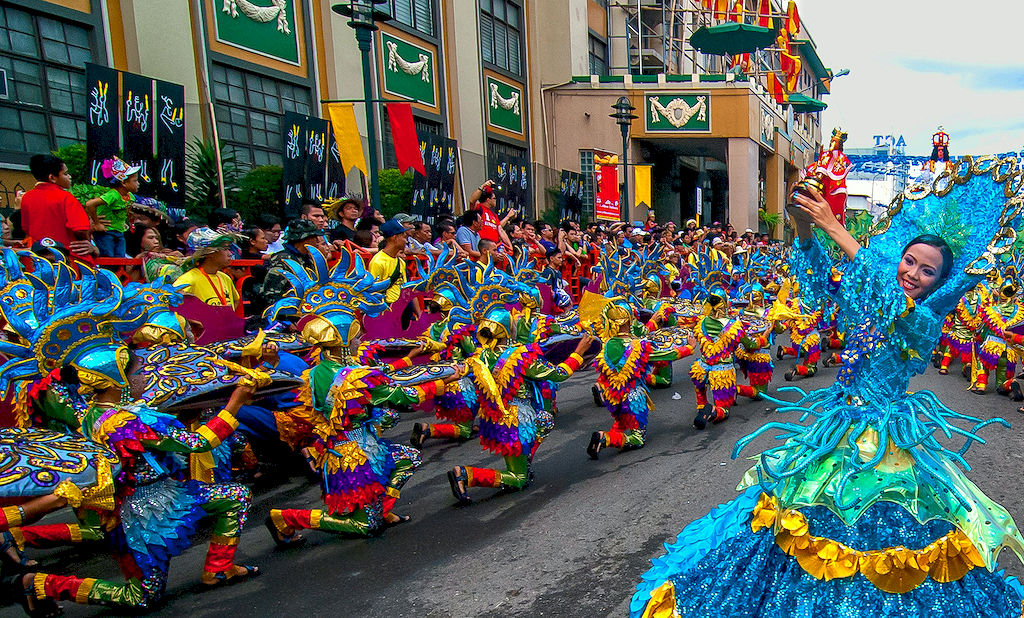
Every third Sunday of January, Cebu shuts down and dances. This year, I danced too — just in my kitchen, with a wooden spoon standing in for a candle.
The first thing that hits you about Sinulog isn’t the costumes or the floats. It’s the drums.
You feel them before you understand what’s happening — a beat that seems to come from the pavement itself, from somewhere under the crowd, and doesn’t stop for hours. Growing up in Cebu, Sinulog wasn’t something I watched. It was something my whole body knew how to do. Two steps forward, one step back, arms swaying like I was pushing something gently out of my way. Every Cebuano learns that rhythm the way you learn to walk.
This year, I danced it in my kitchen. Alone, in wool socks, with a wooden spoon standing in for a candle, while a livestream played on my phone propped against the toaster.
What Sinulog actually is
For anyone who hasn’t been, Sinulog is Cebu’s biggest festival, held every third Sunday of January in honor of the Santo Niño — the Child Jesus. The dance itself, the sinulog step, is said to imitate the current of a river: two steps forward, one step back. It’s a festival with layers — devotion at its center, but also street parties, food stalls that never seem to run out of lechon, and a sea of people in glittering costumes moving as one.
Growing up, my lola would already have our clothes laid out the night before. We’d be at the Basilica del Santo Niño before sunrise, packed shoulder to shoulder with people who were strangers ten minutes earlier and best friends by the time the procession passed. I used to complain about the heat, the crowd, the hours of standing. I would give a lot to complain about that heat again.
Celebrating it from here
There’s no version of Sinulog that happens naturally in a Canadian winter. No crowd forms outside my apartment. No smell of grilled corn and puso drifts down my street. If I want any piece of it, I have to build it myself — which, it turns out, is its own kind of tradition now.
This year that meant:
- Waking up at 4 a.m. to catch the livestream of the opening mass, coffee in hand, the room still dark
- Cooking humba from a recipe my mother sent over voice message, correcting my pronunciation of “star anise” along the way
- Calling home right as the fireworks started in Cebu, holding the phone up so I could hear the drums even if I couldn’t feel them
- Wearing a bright red shirt to work the next day, just so something on me matched the day, even if nobody around me knew why
None of it replaced being there. But it didn’t feel like a lesser version of Sinulog, either — it felt like a different room in the same house. The devotion is still the point. The dance still means the same thing, even done small, even done solo, even done in wool socks on tile that’s nothing like Cebu pavement.
For anyone else doing this far from home
If you’re Cebuano and reading this from somewhere cold and quiet, here’s what I’d say: you don’t need a crowd to keep Sinulog. You need the step, the prayer, and someone — even just on the phone — to share it with. Put on something red. Cook something that smells like home. Call someone who’s dancing the real thing right now and let them hold the phone up so you can hear the drums, even faintly, even through a bad connection.
The current still pushes forward, two steps at a time, no matter how far the river runs.
Have your own way of celebrating Sinulog from abroad? I’d love to hear about it — reply to this post or find me on [your social link].